COAT OF ARMS
COAT OF ARMS
ScnAdmin
in all ages and places, men have used symbols to communicate. From very early times, we find that people belonging to the same family or group or tribe wore similar clothing. Aside from being a matter of fashion, this also made it easy to identify one's group members even at a distance. In the Middle Ages, it became even more important to develop distinguishing symbols since a knight in full armor is not easy to identify. So the practice of designing distinguishing symbols and designs to be used by the knight, his retinue, his family and group became a very important art and science. Soon, every knight had his distinguishing marks which represented not only his symbolic prowess but also the heritage of his family and its connections. The coat of arms as a whole consists of several major parts: the crest, the mantling, the shield or escutcheon (a word coming from the Latin word, scutum, meaning shield) and the motto. If you inspect a coat of arms as a whole, knowing the relationship of the parts, you will see how it derives from a very simple representation of the basic armor of a knight, along with its distinguishing symbols, with the motto as the guiding principle on which he and his group operate, set just beneath it. The coat of arms became the rallying point and sign of recognition for any group of people. By it, they could identify themselves as a group with common purposes, common goals. (FO 3350) 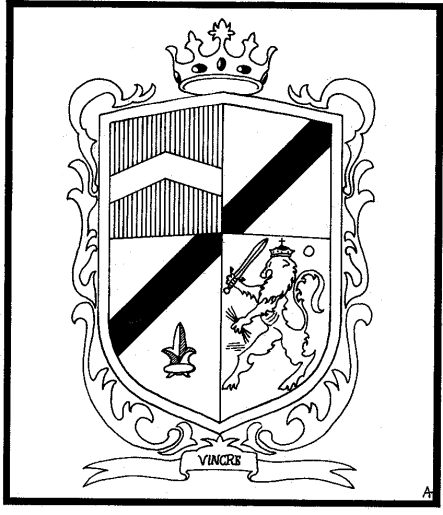
Coat of Arms